

Your broker's matching engine sits in a rack somewhere in Singapore. Your home laptop sits a couple of hundred milliseconds away on flaky Wi-Fi. That little gap? Yeah, that is where your pips quietly bleed out on every fill.
We have been renting, testing and killing off Singapore forex VPS hosting accounts at TradingVPSHub since our first blown account taught us a lesson no course ever did. So this guide is not a vendor copy. Real deployments, real broker pings, honest scores.
Quick answer: For the fastest Forex VPS in Singapore in 2026, ForexVPS.net and TradingFXVPS lead on raw Equinix SG1 data centre latency. NYCServers wins for instant deployment and multi-broker desks.
Kamatera flexes for elastic scaling, Contabo for high-RAM multi-account setups, FXVM for a trader-only network, and AccuWeb Hosting for fully managed, hands-off Asian market trading VPS coverage.
Why Singapore anchors the Asian session for serious desks
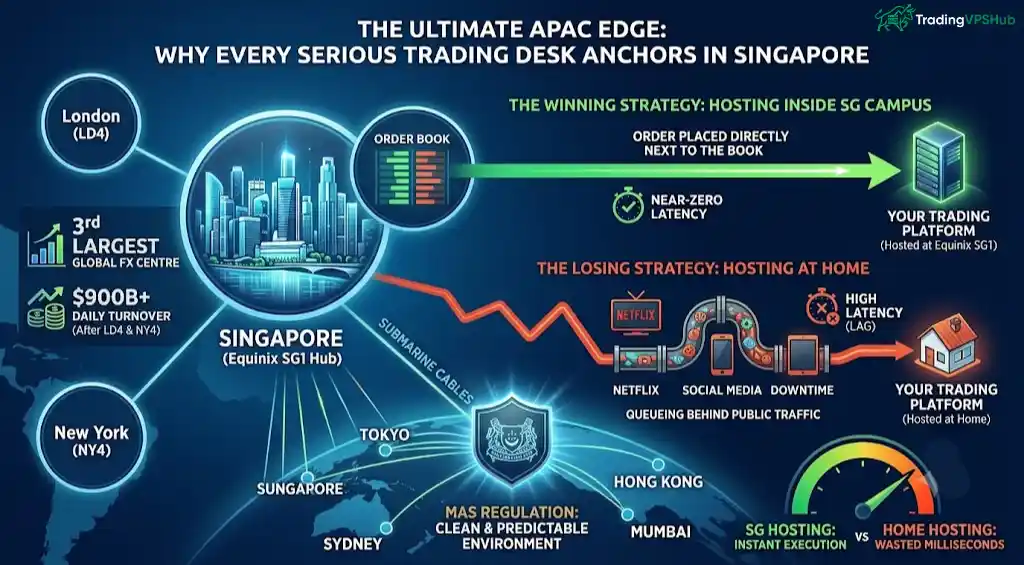
Singapore is not a random dot on the map. It ranks as the third largest foreign exchange centre on earth, moving well over $900 billion in daily turnover. Only London and New York trade more. So when Asian liquidity wakes up, a huge slice of it flows through this one city.
The heart of it is Equinix SG1, sitting at One-North on Ayer Rajah Crescent. Think of it as the APAC twin of LD4 in London and NY4 in New York.
Brokers park their trade servers there. Liquidity providers peer there. Submarine cables fan out from there to Tokyo, Sydney, Hong Kong and Mumbai.
Plus, the Monetary Authority of Singapore keeps the whole scene clean and predictable, which is partly why so many APAC forex brokers route through the SG campus in the first place. Host your platform inside that ecosystem and your orders sit right next to the book. Host it at home and they queue behind your Netflix.
The 200ms trap that quietly bleeds Asian traders
Here is the cruel twist most Singapore traders learn the hard way. You can live in the fastest-wired country in Asia and still run 200ms to 300ms pings on your fills. How? Because your broker server location may sit in London or New York, not down the road from you.
Physical distance is the one thing no amount of local fibre can fix. A signal to LD4 and back takes time light itself cannot beat. So the fix is not a faster home line. The fix is putting your terminal beside the broker matching engine it talks to.
That is the whole game with ultra-low latency trading. If your broker holds APAC trade servers in SG1, a Singapore box gets you sub-1ms latency to SG1. If your broker lives in Tokyo TY3 or Hong Kong HK1, you want a provider with a node there too. Right tool, right city.
💡 Trade the Asian trading session and love JPY AUD NZD pairs? A Singapore node also catches the Asia-London overlap window near 07:00 to 09:00 GMT, when Asian and European order flow collide and spreads tighten. Being close to the book during that hour pays for the whole month.
How the TradingVPSHub bench pressure-tested these seven
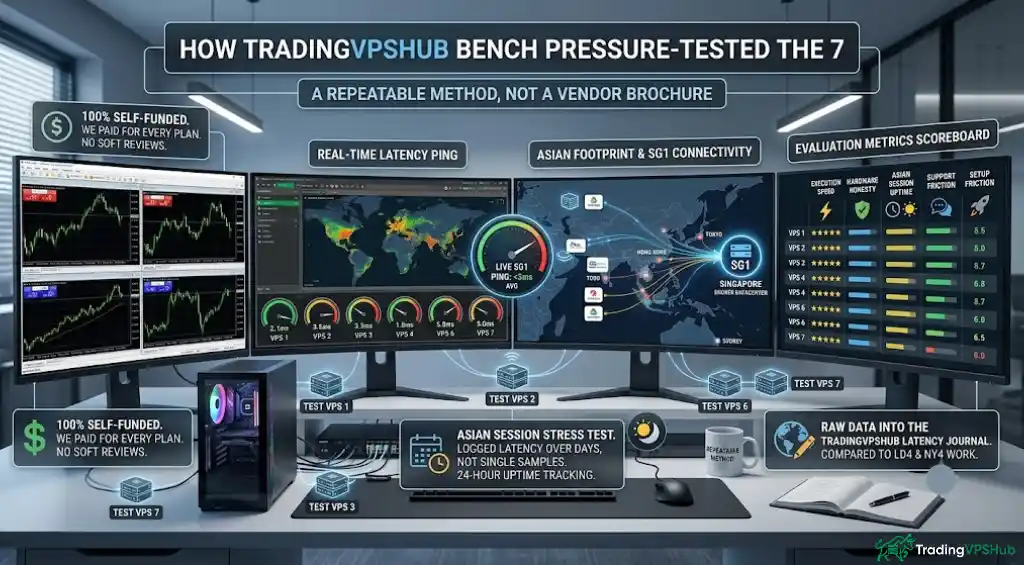
We do not recycle vendor brochures. Our method is boring on purpose, because boring is repeatable.
Every score below reflects that testing. And yes, the raw pattern goes into the TradingVPSHub latency journal, same as our LD4 and NY4 work. Now to the seven.
The Singapore desk, seven providers side by side
| Provider | Asian footprint | Ping signature to SG brokers |
|---|---|---|
| Kamatera | Singapore + Tokyo, HK, Sydney cloud region | Low single-digit ms, scalable nodes |
| ForexVPS.net | SG1 + Tokyo, plus Alibaba CEN mesh | Around 1ms, trader-tuned path |
| Contabo | Singapore SEA node | Higher, value over raw speed |
| FXVM | SG1 Equinix, trading-only fabric | Sub-1ms execution band |
| TradingFXVPS | SG1 Equinix, Singapore operator | 0.3ms to 0.9ms cross-connect |
| AccuWeb Hosting | Singapore data centre + network tester | 1ms to 4ms to regional brokers |
| NYCServers | SG1 + HK1, six-hub Equinix map | Sub-2ms, OctaFX near 0.99ms |
Read the table as a shortlist, then read the story behind each below. Because a spec sheet never tells you how a box actually behaves when NFP hits and the Yen goes vertical.
1. Kamatera

Start with the one that thinks in clouds, not just trading. Kamatera opened its Singapore region as part of a wider Asia push alongside Tokyo and Sydney, giving desks a proper Southeast Asia base rather than a repurposed web host.
What makes it click for Asian coverage is the build-your-own model. You dial CPU, memory and storage up the exact moment you add a second or third funded account, then dial back after a prop challenge ends. So a trader growing a copy-trading book across the region never pays for headroom before it is needed.
Better yet, the Singapore node sits inside the same 24-region mesh as Hong Kong and Tokyo. Route a backup terminal to a second Asian city and you get a clean failover plan for BOJ or RBA news nights, without leaving one provider's dashboard.
| Silicon | Intel Ice Lake class, configurable cores |
| Memory & disk | NVMe SSD, resize on demand |
| Uptime posture | 99.95% with N+1 power and cooling |
| Platforms | Windows Server or Linux, any MT4/MT5 setup |
| Try it | 30-day window to kick the tyres |
| Asian edge | True APAC multi-city footprint for redundancy |
⚠️ Honest note: it is a general cloud, not a forex-only fabric. You will do a touch more setup than on a pre-tuned trading host. Fine for tinkerers, less so for total beginners.
2. ForexVPS.net

Now the one built by traders, for traders, since 2013. ForexVPS.net has served over two million accounts, and every location is colocated inside premier financial venues like Equinix, the same halls where brokers stack their own servers.
For Asian coverage, the clever bit is its Liquidity Connect layer. MetaTrader proxy servers ride Alibaba's CEN backbone, a private high-speed mesh stitching Singapore to Tokyo, Sydney, Jakarta, Kuala Lumpur, Hong Kong and even mainland China past the Great Firewall. So a Jakarta scalper on an SG1 broker gets a stable, short path that public internet cannot promise.
That focus shows in the little things. No bloggers or game servers share the fabric. Just Expert Advisor hosting and terminals, tuned so orders reach the book with almost nothing in the way. It earns the top score because nothing here fights the trader.
| Network reach | 21+ Equinix-class hubs worldwide |
| APAC routing | Alibaba CEN private backbone mesh |
| Address | Dedicated IP available without a tier jump |
| Platforms | Every EA, bot, algo and MetaTrader build |
| Safety net | 14-day money-back on plans |
| Asian edge | Private path into China and SE Asia cities |
⚠️ Honest note: pure trading polish means no web-hosting extras. If you wanted a VPS that also runs a website on the side, look elsewhere. For fills, though, it is our sharpest of the seven.
3. Contabo
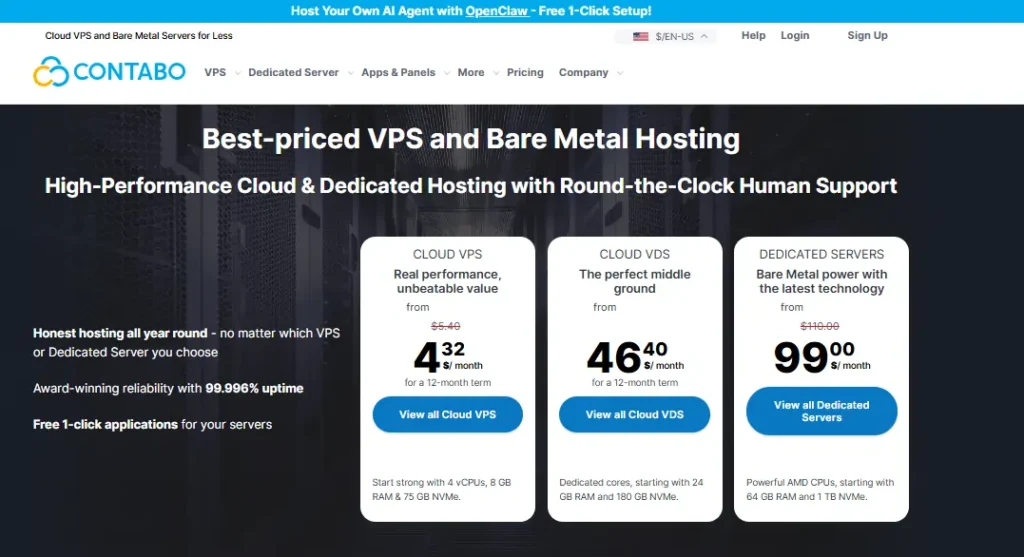
Next, the value monster from Munich. Contabo has run its own metal since 2003 and opened a Singapore facility to bring that famous resource-per-dollar deal into Southeast Asia.
Where it shines for Asian desks is raw capacity for slower styles. If you swing-trade the Nikkei correlation or park five or six accounts across brokers, Contabo gives you the memory and disk to hold every chart, journal and backtest without flinching. It is the box for a busy multi-account book, not a knife-edge scalper.
Its Singapore node runs the same German hardware blueprint as everywhere else, wired through Telia as a Tier 1 carrier and Hurricane Electric for strong Asian reach.
So performance stays predictable, which matters more than headline speed once your strategy is not counting single milliseconds.
| Silicon | AMD EPYC server cores |
| Memory posture | Big RAM and storage per plan |
| Uplink | Telia Tier 1 plus Hurricane Electric |
| Facility | ISO-certified, nitrogen fire suppression |
| Platforms | Windows Server and full Linux range |
| Asian edge | Most headroom here for heavy multi-account setups |
⚠️ Honest note: a Singapore location fee applies, and pings run higher than the SG1-colocated crowd. Great for capacity, wrong pick for sub-millisecond scalping.
4. FXVM
Then comes the trading-purist. FXVM plants its Singapore box straight inside the Equinix data centre and, crucially, keeps everything else off the network. No websites, no rich media, nothing that could jitter your connection.
For Asian scalpers, that discipline is the feature. A quiet fabric means your fills stay consistent through the Sydney and Tokyo opens, when volatility spikes and a noisy neighbour would normally cost you a tick. Add remote desktop and VNC access, and you can babysit an EA from a phone on the MRT.
It also flexes for power users. The bigger tiers hold a stack of terminals at once, so a signal-copier feeding many SG1 broker accounts has room to breathe. And a cheap trial lets you test your own broker's ping before committing a cent.
| Silicon | Top-tier Intel chips |
| Density | Runs many terminals on higher tiers |
| Access | RDP and VNC from any device |
| Fabric | Traders and financial apps only |
| Try it | 7-day trial for pocket change |
| Asian edge | Clean, jitter-shy path during volatile opens |
⚠️ Honest note: the trading-only rule means it will not double as a general server. That is the point, but know it going in.
5. TradingFXVPS
Here is the local hero. TradingFXVPS is operated out of Singapore itself, and it leans hard into the one metric MetaTrader actually cares about, single-core clock speed.
Why does that matter for Asian fills? Because MT4 processes a tick on one thread, and MT5 gives each EA its own thread. So the faster each core runs, the quicker your terminal reads a price and fires the order. TradingFXVPS builds around AMD Ryzen 9 silicon at high clocks for exactly this reason, which is smarter than piling on cores a chart never uses.
Sitting inside SG1 with direct links to brokers like IC Markets, Pepperstone, Eightcap, Axi and FXCM, it delivers the tightest cross-connect on this list. For a scalper or HFT-lite EA trader hunting the Asia-London overlap window, that headroom is the difference between a fill and a re-quote.
| Silicon | AMD Ryzen 9 at high clock, DDR5 memory |
| Network | 10Gbps links, SolarFlare NICs on HFT line |
| Operator | Singapore-based trading network |
| Platforms | MT4, MT5, cTrader, NinjaTrader, custom EAs |
| Try it | Short paid trial, 100% uptime pledge |
| Asian edge | Tightest SG1 cross-connect for scalpers |
⚠️ Honest note: plan cards do not always name the exact Ryzen chip, so confirm the SKU and your Windows Server version at checkout if that detail matters to you.
6. AccuWeb Hosting

Now the old hand. AccuWeb Hosting has been in the game since 2003 and folds a Singapore data centre into a wide global map, with 1ms to 4ms pings to the major brokers active in the region.
Its real gift to Asian traders is the built-in network tester. Before you pay, you can check the live path from Singapore to your specific broker and see the number for yourself. That takes the guesswork out of the one question that decides everything, will this box actually be close to my book.
The support desk is the other draw. Two decades of forex hosting means the staff know MT4 quirks, EA installs and broker gotchas, and they answer on phone, chat and ticket around the clock. For a trader who wants a hand rather than a control panel, that steadies the nerves.
| Track record | Forex hosting since 2003 |
| Storage | SSD with 1Gbps port speed |
| Uptime | 99.99% guarantee, round-the-clock watch |
| Tooling | Live latency checker before you buy |
| Safety net | 7-day money-back window |
| Asian edge | Verify your broker path first, then commit |
⚠️ Honest note: it is neither the cheapest nor the outright fastest here. You pay a little for the veteran support, and for many traders that trade is worth it.
7. NYCServers
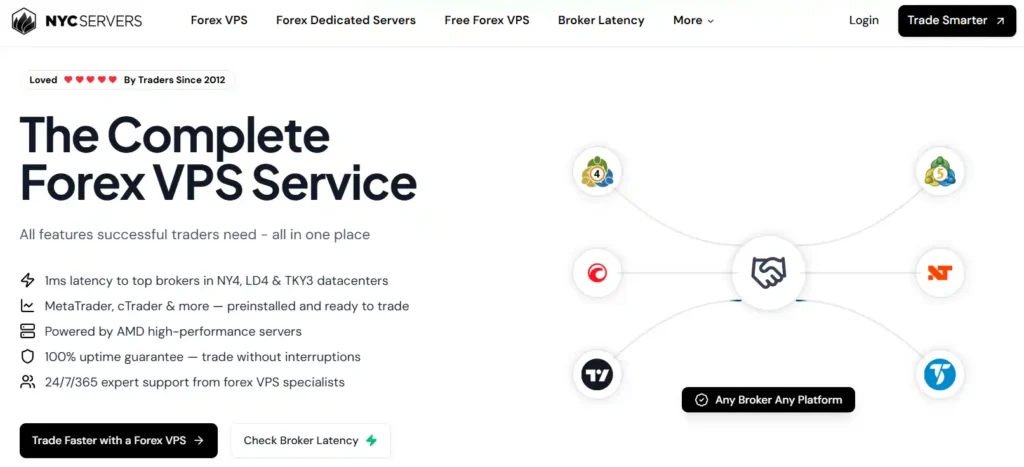
Finally, the speed-and-simplicity pick. NYCServers has served traders since 2012 and now spreads across six Equinix hubs, with Singapore SG1 and Hong Kong HK1 covering the Asian map between them.
Setup is where it wins the day. Order a Singapore box and it is live in about 30 seconds, with MT4, MT5, cTrader and TradingView already on the desktop, plus your broker pre-wired.
For a trader who wants to test a strategy on OctaFX or Exness tonight, that near-instant start beats an hour of fiddling.
Underneath sits current-gen kit, DDR5 memory and NVMe storage on Windows Server 2022, tuned with broker-optimised peering into names like IC Markets, Pepperstone, OANDA and IG. Add sub-2ms fills to supported SG1 brokers and a full uptime pledge, and it is a clean, modern base for any Asian desk.
| Hardware | DDR5 RAM, NVMe on Windows Server 2022 |
| Asian hubs | SG1 plus HK1 for two-city cover |
| Setup | Live in roughly 30 seconds, platforms pre-loaded |
| Peering | Broker-optimised routes to 100+ names |
| Pay & refund | Card, PayPal or crypto, 14-day refund |
| Asian edge | Fastest onboarding for a same-night start |
⚠️ Honest note: entry tiers ship modest memory, so a heavy EA stack wants the step-up plan. Read the resource line before you load ten charts.
Pairing your broker's server with the right Singapore node
So which box actually fits? Answer one question first: where does your broker keep its trade server? That single fact beats every marketing claim on this page.
If your broker lists Singapore or holds APAC servers in the SG campus, like many IC Markets and Pepperstone setups, an SG1-colocated plan hands you the shortest hop. That covers TradingFXVPS, FXVM, NYCServers and ForexVPS.net cleanly.
Trade a Tokyo-hosted feed instead? Then a Tokyo TY3 node beats a Singapore one, and providers with a matching city win. Chase Hong Kong flow and HK1 is your friend. Match the city, not your postcode, and the pips follow.
What genuinely moved fills in 2026, and what is just noise
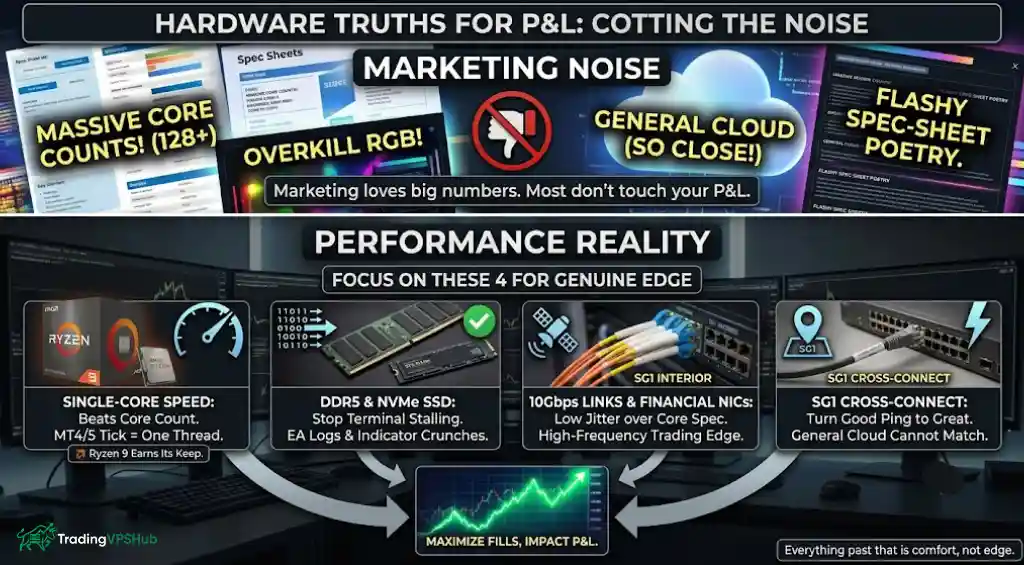
Hardware marketing loves big numbers. Only a few of them touch your P&L. So let us cut it down.
Everything past that is comfort, not edge. Chase the four things above and ignore the rest of the spec-sheet poetry.
Forex VPS Singapore, quick trader FAQ
What is the best Forex VPS in Singapore for Asian markets?
For desks trading into SG1 brokers, ForexVPS.net and TradingFXVPS give the tightest execution, while NYCServers and FXVM keep setup simple. The real answer depends on where your broker hosts its matching engine, so match the node to that city.
Why does a Singapore Forex VPS beat trading from home?
A home line often runs 200ms to 300ms to a broker parked overseas. A box inside the Equinix SG1 data centre sits beside the book, dropping that to roughly 1ms and cutting the slippage that eats scalping profits.
Which brokers sit inside Singapore's SG1 campus?
Many APAC setups from IC Markets, Pepperstone, Eightcap, Axi and others route through the SG campus. Always test your own broker's path first, since some MAS-regulated names still host in London or New York.
Do I need a Singapore node for JPY, AUD or NZD pairs?
If your broker holds APAC trade servers, yes. A Singapore box gives the shortest hop to the broker matching engine for those regional pairs, and it also catches the Asia-London overlap when spreads tighten.
Can one Singapore VPS run multiple MT4 and MT5 accounts?
It can, as long as the plan carries enough memory and clock speed. Trading-focused hosts like FXVM pack many terminals on higher tiers, while Contabo and Kamatera give big-book traders extra headroom.
Does a Forex VPS in Singapore really cut slippage?
Yes. Shorter physical distance plus optimised broker peering means orders reach the book in milliseconds, so the price you click is far closer to the price you get, especially during volatile Asian opens.
Our TradingVPSHub verdict on the Asian desk
After renting all seven and pinging them into live SG1 books, the map is simple. ForexVPS.net and TradingFXVPS give the crispest execution for scalpers and EA runners glued to the Asian trading session.
NYCServers and FXVM keep things fast and fuss-free. Kamatera and Contabo hand growing multi-account books the most room. And AccuWeb Hosting is the safe harbour when you want a human on the line.
Truth is, there is no single winner, only the right match for your broker and your style. Pin down where your book lives, then pick the provider closest to it. Do that, and a Singapore Forex VPS hosting plan stops being an expense and starts being the quiet edge behind every clean fill.
We will keep re-pinging these boxes each cycle and update the TradingVPSHub journal when the numbers shift.